HSC English Advanced Common Module 2026: What Every NSW Student Needs to Know
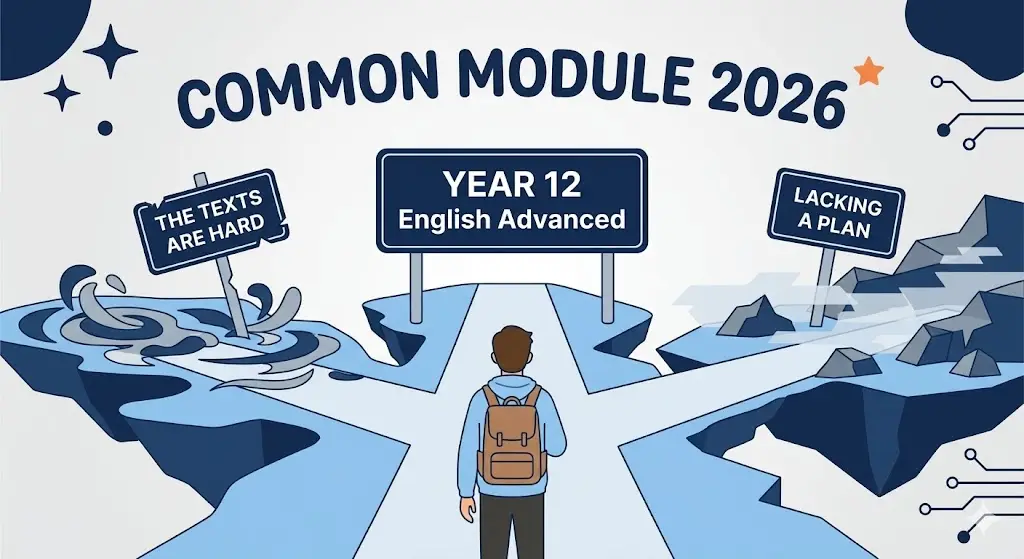
HSC English Advanced trips up more Year 12 students than almost any other subject. Not because the texts are hard, but because most students have never been taught what NESA markers actually look for. This guide breaks down the 2025 Common Module requirements and explains exactly how Band 6 students structure their responses.
What is the Common Module?
The Common Module, “Texts and Human Experiences,” is studied by every English Advanced student in NSW. It is worth 20 marks in the HSC exam and a significant proportion of internal assessments. The module asks students to explore how texts represent human experiences, including the anomalous, the challenging, and the confronting.
What makes it difficult is that the question is always unseen. Students cannot predict the exact phrasing of the question, which means generic essay templates almost never work. The students who score Band 6 have practised answering a wide variety of questions about their prescribed text, not memorised a single essay.
Your prescribed text and what it demands
The Common Module prescribed texts for 2025 include works across prose fiction, poetry, and drama. Regardless of which text your school has chosen, NESA markers look for the same things across all texts and all student responses. The ability to connect the text’s representation of human experience to the module’s central concerns is non-negotiable for Band 5 and above.
Many students make the mistake of summarising what happens in the text. Markers already know the text. They are looking for your analysis of how the text constructs meaning about human experience through specific language techniques, structure, and perspective.
The Band 6 essay structure
A Band 6 Common Module essay consistently does four things that lower-band essays do not:
- It answers the question directly in the first sentence of the thesis. Not “throughout the module,” not “in many texts,” but a direct statement of what the text does in relation to the question asked.
- It integrates evidence. Quotes are not dropped into sentences after a colon. They are woven into the analysis. “Through the motif of the recurring window, Woolf positions Mrs Dalloway as a character who observes but cannot participate in the human experiences around her.”
- It names specific techniques and explains their effect. Saying a metaphor is used is not enough. Explaining what the metaphor does to the reader’s understanding of the character’s experience is what earns marks.
- It connects to the module’s conceptual concerns. Every paragraph should loop back to the idea of human experience, not just the text itself.
Related texts: what markers expect
Students must bring at least one self-selected related text to the HSC exam. The related text should complement or contrast the prescribed text’s treatment of human experience in a meaningful way. A strong related text:
- Allows you to draw a specific, analytical comparison rather than a vague thematic similarity
- Gives you language technique examples you can analyse with the same rigour as your prescribed text
- Has been practised across multiple question types, not just one essay you memorised
The most common related text mistake is choosing a text for personal interest and then struggling to connect it analytically to unfamiliar exam questions. Choose a text where you have at least five strong technique examples you can deploy flexibly.
Module A, B, and C at a glance
Module A: Textual Conversations asks students to compare two texts and explore how they speak to each other across time, context, or perspective. The key skill is not just identifying similarities and differences but explaining what those connections reveal about the texts and their contexts.
Module B: Critical Study of Literature goes deeper into a single text than any other module. Students need a comprehensive understanding of the text, its critical reception, and their own evaluative perspective. The danger here is writing a rehearsed summary instead of a critical evaluation of the text’s literary value.
Module C: The Craft of Writing is the creative and reflective component. Students produce their own creative writing in response to a stimulus and write a reflection on their process. Many students underestimate Module C. It is worth as many marks as the other modules and rewards students who have practised writing in a range of forms, not just the one they are comfortable with.
Year 11 preparation that makes Year 12 easier
The students who find HSC English Advanced most manageable in Year 12 are the ones who built their essay technique scaffold in Year 11. The preliminary course covers many of the same analytical skills under different contexts. If you are currently in Year 11, the most valuable thing you can do is learn to analyse texts with technique precision now, rather than learning the technique and learning the HSC texts simultaneously in Year 12.
LearnCore’s HSC English Advanced tutoring works through both Year 11 and Year 12 programmes. We teach a specific essay scaffold that is flexible enough to answer any question NESA sets, and we practise it across multiple past papers so students arrive at the exam with genuine confidence rather than a memorised response.
Book Your Free Trial Lesson
Tell us about your child and we will match them with a specialist HSC tutor. The first lesson is free, with no lock-in.
- WWCC-verified tutors
- First lesson free
- No lock-in contracts
- A real person calls you back the same day, usually within two hours.
- No payment and no account. The first lesson is free either way.
- Your number is used to arrange the lesson, nothing else. Reply STOP to any text and we stop.
Rated 5 out of 5 stars by Sydney parents