Is Online Tutoring Effective for High-Level HSC Science? What the Evidence Shows for Chemistry and Physics
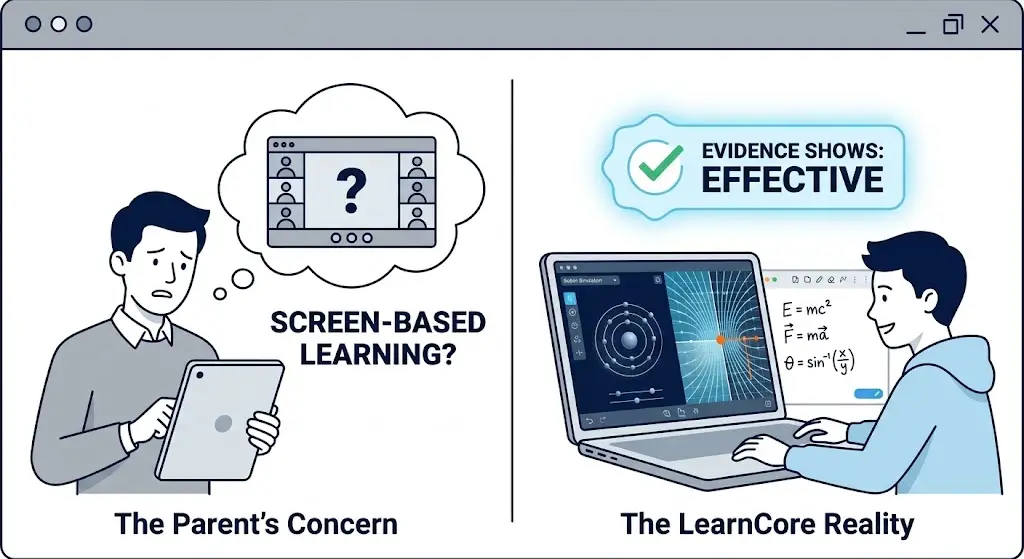
If you are a parent considering online tutoring for your child’s HSC Chemistry or Physics and you are not entirely sure whether a screen-based learning environment can match what a face-to-face session delivers for a rigorous, mathematically demanding science subject, that is a sensible question. It deserves a direct, evidence-based answer rather than a marketing dismissal.
The short answer is that the relevant question is not “online versus face-to-face.” It is “specialist versus generalist.” A mediocre face-to-face tutor delivering generic science support is significantly less effective than a specialist online tutor with deep HSC Chemistry or Physics curriculum knowledge, regardless of the physical setting. The delivery mechanism matters far less than the depth of subject expertise and the quality of feedback.
But let us go further than that, because the structure of a purpose-built online science tutoring environment is not simply an equivalent alternative to face-to-face delivery. For senior HSC students specifically, it has several genuine advantages that the traditional model cannot replicate.
The Shift That Parents Should Focus On
When parents assess tutoring options for their Year 11 or Year 12 child, the tendency is to focus on familiarity. Face-to-face tutoring is familiar. Sitting across a table from a tutor, working through problems on paper, feels like a known quantity with a known outcome.
The question worth examining, however, is not which format feels more familiar. It is which format delivers the best outcomes for a student navigating the specific demands of HSC Chemistry and Physics.
Those demands are specific. They include mastering complex mathematical derivations, understanding the precise language of NESA marking rubrics, applying formula frameworks to unseen questions under timed conditions, and building the kind of rapid-access fluency that only comes from repeated deliberate practice with expert feedback.
The question is whether the tutor you are considering has the curriculum depth to deliver that kind of support. A former HSC Chemistry marker who understands how extended-response criteria are applied can provide feedback in an online session that a general-science face-to-face tutor working from a textbook simply cannot match, regardless of where they are sitting.
The Structural Advantages of a Premium Online Environment
Once the curriculum-specialist question is settled, the delivery format becomes a secondary but still meaningful consideration. And here, a well-designed online science tutoring environment offers several concrete advantages that matter specifically for HSC Chemistry and Physics students.
Real-time collaborative digital annotation
In HSC Chemistry and Physics, the most important learning happens in the derivation: watching a formula being built from first principles, or seeing a vector diagram constructed step by step with reasoning attached to each line. In a traditional tutoring setting, the tutor writes on a whiteboard or notepad and the student watches.
In a purpose-built online environment, both the tutor and the student write simultaneously on a shared digital whiteboard. The student does not watch a derivation being completed. They co-construct it, with the tutor guiding and correcting in real time. A student working through a projectile motion vector decomposition in this environment is actively building the diagram with their own hand, not passively copying from the front of a room. The cognitive difference between active construction and passive observation is significant, particularly for procedural knowledge like formula derivation.
Molecular diagrams, Lewis structures, organic chemistry reaction mechanisms, circuit diagrams, and electromagnetic field representations are all producible at high fidelity on a collaborative digital canvas, with annotation layers that the student can revisit and review between sessions.
Instant access to targeted resources
In an online session, a tutor can share a NESA marking guideline, a specific past-HSC question, an annotated worked solution, or a module-specific formula reference in seconds. There is no printing, no photocopying, no “I will bring that next week.” The resource appears in the shared screen environment immediately and the student can download and retain it for independent study.
For HSC Chemistry and Physics revision, where past-paper practice with marking-guideline feedback is the single most effective preparation strategy, this matters. A student working through a 2022 HSC Chemistry extended-response question with the actual NESA marking criteria open beside their response in the same window is learning exactly what a marker is looking for. That is a qualitatively different experience from working through the question without the marking criteria, or having the marking criteria arrive as a photocopy the following week.
Explore LearnCore’s specialist HSC Chemistry and Physics online tutoring programmes, built around this resource infrastructure.
Recovering the two hours per week that commuting costs
This point is less glamorous than real-time whiteboard collaboration, but for Year 12 students in Sydney it may be the most practically significant of the three.
A student travelling from the Hills District, Northern Beaches, or the Inner West to a tutoring centre in a major hub and back is spending between 90 minutes and two-and-a-half hours in transit per session. Across a standard tutoring engagement of one or two sessions per week, that amounts to between three and five hours per week of prime study time being consumed by travel.
In Term 3 of Year 12, with trial examinations approaching and multiple simultaneous assessment deadlines, those hours are not a minor inconvenience. They represent a significant fraction of the discretionary time available for HSC preparation.
Eliminating the commute through online tutoring for Year 12 HSC students does not simply save time. It reduces fatigue. A student who joins a tutoring session from their desk, with their notes in front of them, is more cognitively present than a student who has just spent forty-five minutes on a train. A student who finishes a session and returns immediately to their study environment, without a travel buffer, is more likely to consolidate what they have just covered while it is still fresh.
This time and energy recovery compounds across a full term. It is one of the most underappreciated advantages of online delivery for senior students.
What Effective Online Science Tutoring Actually Looks Like
It is worth being specific about what a high-quality online HSC Chemistry or Physics tutoring session involves, because the answer is somewhat different from the default image of “student shares screen while tutor talks.”
A session with a specialist HSC tutor in an online environment begins with a targeted warm-up: two or three short-answer questions drawn from recent past-paper material, completed independently by the student in the first ten minutes while the tutor observes. This immediately reveals where the student’s understanding is strong and where it requires attention, without the student having to self-report their gaps (which students consistently underestimate).
The session then moves to the primary focus area: a concept explanation, a derivation walkthrough, a marked extended-response review, or a worked-example sequence, depending on what the warm-up revealed and what the student’s assessment schedule requires. This is conducted on the collaborative whiteboard, with both parties writing, annotating, and building diagrams together.
The final portion of the session is a consolidation task: an unseen question or problem set, completed by the student independently with the tutor available for support. The session ends with a clear, specific written summary of what was covered, what was understood, and what requires further independent practice before the next session.
This structure is replicable in a face-to-face setting. But the digital environment offers genuine enhancements at each stage: the warm-up questions can be drawn from a searchable past-paper bank and presented instantly. The derivation walkthrough happens on a shared canvas that the student retains. The consolidation task can include annotated feedback that the student reviews asynchronously.
The Honest Conclusion
Online tutoring is not automatically superior to face-to-face tutoring. Neither is the reverse true. The delivery medium is a secondary variable. The primary variable is the quality of the tutor and the depth of their subject and curriculum knowledge.
What is true is that a high-quality, purpose-built online environment for HSC Chemistry and Physics tutoring is not a compromise. It is a fully capable, and in several specific respects structurally advantaged, alternative to the traditional tutoring centre model. The collaborative digital tools, the instant resource access, and the recovery of commuting time all serve senior students well.
If your child is in Year 11 or Year 12 and is preparing for HSC Chemistry or Physics, the decision about where they study matters far less than the decision about who they study with.
Reach out today to arrange a diagnostic session with one of our HSC science specialists. The first conversation will tell you immediately whether the level of curriculum depth we offer is what your child needs.
Book Your Free Trial Lesson
Tell us about your child and we will match them with a specialist HSC tutor. The first lesson is free, with no lock-in.
- WWCC-verified tutors
- First lesson free
- No lock-in contracts
- A real person calls you back the same day, usually within two hours.
- No payment and no account. The first lesson is free either way.
- Your number is used to arrange the lesson, nothing else. Reply STOP to any text and we stop.
Rated 5 out of 5 stars by Sydney parents