HSC Physics Module 6 Electromagnetism: How to Write Band 6 Long-Response Answers
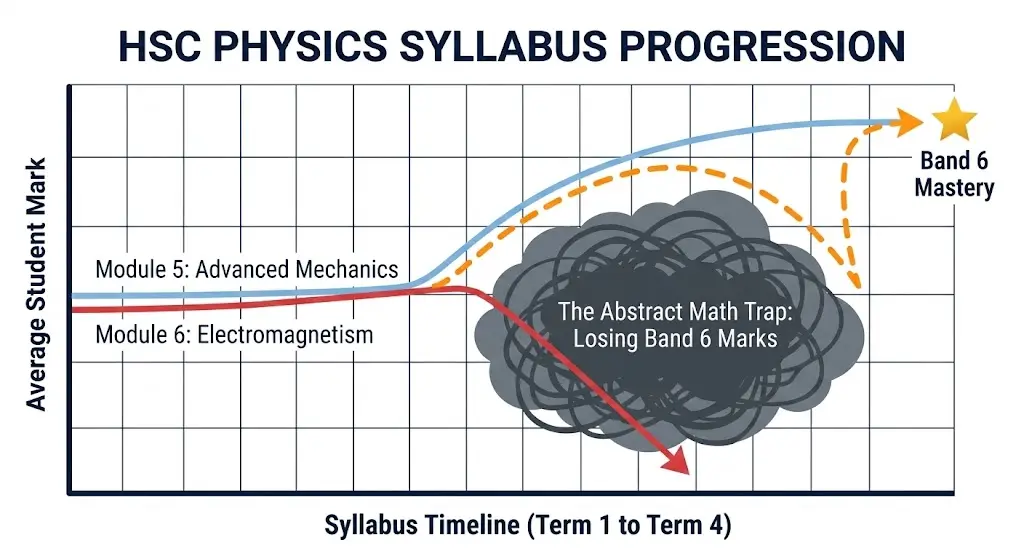
Module 6 Electromagnetism is where many HSC Physics students lose the most marks. The concepts are not inherently more difficult than Module 5 Advanced Mechanics, but the long-response questions require a specific technique that most students have never been explicitly taught. This guide explains exactly what NESA markers look for and how to structure Band 6 responses.
What Module 6 covers
HSC Physics Module 6 Electromagnetism covers four main content areas: the relationship between electric and magnetic fields, electromagnetic induction, applications of the motor effect, and Maxwell’s contribution to understanding electromagnetic radiation. The module builds on the Year 11 Electricity and Magnetism module and extends those concepts into more complex and unfamiliar contexts.
The challenge with Module 6 is not memorisation. It is application. NESA questions consistently place students in novel situations involving electromagnetic phenomena and ask them to explain, predict, or evaluate using the principles from the module. Students who have memorised dot points struggle; students who understand the underlying relationships do not.
The three types of Module 6 long-response questions
Looking at past HSC Physics papers, Module 6 long-response questions fall into three broad categories:
- Explain or describe questions – “Explain how an alternating current generator produces an EMF.” These require a clear, sequenced explanation using correct physics terminology and often a supporting diagram.
- Evaluate or justify questions – “Evaluate the impact of Maxwell’s prediction of electromagnetic waves on the scientific community’s understanding of light.” These require a balanced analysis that weighs evidence and reaches a supported conclusion.
- Calculate and explain questions – “A conductor of length 0.5 m carries a current of 3 A in a magnetic field of 0.4 T. Calculate the force on the conductor and explain its direction.” These combine quantitative working with a conceptual explanation.
Many students treat all three types identically and lose marks on the explain component even when their calculations are correct. The calculation is worth marks, but the explanation of what is happening physically is often worth equal or more marks in the marking rubric.
What a Band 6 response actually looks like
Consider a question asking students to explain electromagnetic induction using Faraday’s and Lenz’s laws. A Band 4 response will state that a change in magnetic flux induces an EMF. A Band 6 response will:
- Define the rate of change of magnetic flux using the correct symbol notation
- State Faraday’s law as a relationship: EMF = -N(dΦ/dt)
- Explain what the negative sign represents physically (Lenz’s law: the induced current opposes the change)
- Apply these principles to the specific context in the question (e.g., a coil being removed from a magnetic field)
- Include a clear, labelled diagram showing the field direction, the induced current direction, and the resulting force
The diagram is not optional for high-level responses in Module 6. Electromagnetic phenomena are inherently spatial, and markers consistently reward students who can represent the three-dimensional relationships between field, current, and force clearly on a two-dimensional page.
The motor effect and its applications
The motor effect content in Module 6 directly extends the Year 11 content about forces on current-carrying conductors in magnetic fields. The key applications students must understand in depth are DC motors, AC generators, and transformers. For each, students need to be able to explain the operating principles, not just identify the components.
Transformer questions are particularly common and frequently mishandled. Students often know the transformer equation (Vp/Vs = Np/Ns) but cannot explain why a transformer works using Faraday’s law of electromagnetic induction. If you can only recall the equation without explaining the physical mechanism, you are capped at Band 4 for those questions.
Maxwell and the nature of electromagnetic radiation
The historical and nature of science content in Module 6 focuses on Maxwell’s unification of electricity, magnetism, and optics through his prediction of electromagnetic waves. Students should know that Maxwell predicted the speed of electromagnetic waves mathematically before Hertz experimentally confirmed them, and that this prediction was a significant departure from the prevailing view that light and electromagnetic phenomena were separate.
“Evaluate” questions about Maxwell’s work appear regularly in HSC exams. A strong response engages with the specific significance of the theoretical prediction preceding experimental confirmation and what this implies about the nature of scientific knowledge, not just what Maxwell did.
How to prepare for Module 6 in the weeks before the exam
The most effective preparation strategy for Module 6 is working through every past HSC Physics question tagged to Module 6 or its Year 11 equivalent, and practising writing the explanation component even when the calculation is straightforward. Many students practise only the calculation and assume they can write the explanation in the exam. They cannot, under time pressure, produce a structured Band 6 explanation without having practised it.
LearnCore’s HSC Physics tutoring covers Module 6 Electromagnetism with a focus on past paper technique and the specific language markers expect in long-response answers. We work through Band 6 model responses and identify the exact features that earn full marks in each question type.
Book Your Free Trial Lesson
Tell us about your child and we will match them with a specialist HSC tutor. The first lesson is free, with no lock-in.
- WWCC-verified tutors
- First lesson free
- No lock-in contracts
- A real person calls you back the same day, usually within two hours.
- No payment and no account. The first lesson is free either way.
- Your number is used to arrange the lesson, nothing else. Reply STOP to any text and we stop.
Rated 5 out of 5 stars by Sydney parents