
The Year 11 to HSC Science Jump: Why Top Students Suddenly Drop Marks in Chemistry and Physics
You have watched your child breeze through junior science for years. They finished Year 10 with strong results, an easy confidence in the lab, and a genuine enthusiasm for how the world works. Year 11 begins, and within a single term, something has shifted. The marks have dropped. The confidence has cracked. And they are spending twice as many hours studying for half the result.
This is not a failure of intelligence. It is the consequence of a transition that the NSW curriculum makes, but that very few families are warned about in advance.
The Year 11 to HSC science jump is one of the steepest academic gradient changes in the entire senior schooling pathway. Understanding why it happens, and what it specifically demands, is the first step toward reversing the decline.
The Year 11 Reality Check
Junior science in NSW is, by design, broad and conceptual. Year 7 through to Year 10 science under the NESA curriculum is structured to build a wide foundation: students learn the vocabulary of science, the logic of experiments, and the basic principles of biology, chemistry, and physics. Questions are largely descriptive. Answers reward recognition and recall. A student who reads carefully, pays attention in class, and has reasonable memory can perform very well.
Year 11 HSC Chemistry and Physics are structurally different subjects.
The moment a student opens their HSC Chemistry or Physics course, they encounter a curriculum that is now primarily driven by quantitative reasoning. Formulae are no longer provided as a convenience. They must be understood, derived from first principles where required, and applied flexibly across novel contexts. The modules are tightly integrated: a gap in Module 5 will compound in Module 7. A student who has not fully internalised the mathematical framework of one topic will be disadvantaged in every topic that builds on it.
In HSC Chemistry, students encounter stoichiometric calculations with multi-step limiting reagent problems, equilibrium constants with precise mathematical relationships, and electrochemical cell potential calculations that require both conceptual and numerical fluency. A student who performed well in Year 10 by understanding “what happens” in a reaction now needs to calculate exactly how much, at what rate, and under what thermodynamic conditions.
In HSC Physics, the shift is equally abrupt. Projectile motion and circular motion require vector decomposition and simultaneous equation solving. The electromagnetic induction module requires students to derive relationships from Faraday’s law rather than simply recite them. Relativity, wave mechanics, and quantum theory all introduce abstract mathematical frameworks that have no equivalent in junior science.
The student has not become less capable. The curriculum has changed what capability means.
If your child is navigating this transition and showing signs of early difficulty, specialist support from the beginning of Year 11 makes a measurable difference. HSC Chemistry tutoring from curriculum specialists and HSC Physics tutoring tailored to the NSW syllabus can close the gap before it compounds across the full two years of senior study.
The Study Habits the Transition Demands
The study strategies that produced strong results in junior science are largely ineffective for HSC Chemistry and Physics. Re-reading notes, highlighting textbooks, and reviewing worked examples passively will not build the active fluency these courses demand. Students who continue those habits into Year 11 produce the same pattern: high time investment, low mark return, mounting frustration.
Build a formula derivation playbook, not just a formula sheet.
Every formula in HSC Physics and Chemistry has an origin. It was derived from a more fundamental principle. Students who understand the derivation can reconstruct the formula under exam pressure, adapt it to unseen contexts, and explain it in extended-response questions. Students who have memorised the formula without understanding its basis are one unusual question away from a blank page.
The practical approach is to build a personal derivation playbook: a dedicated section of notes where each formula is written out with its derivation from first principles, a worked example, and a note on the common exam contexts in which it appears. This is more demanding to build than a formula summary, but it pays dividends across the entire HSC.
Map the module chokepoints before they appear in assessment.
Every HSC Chemistry and Physics module has one or two concepts that serve as chokepoints: ideas that, if not properly understood, block access to multiple subsequent topics. In Chemistry, equilibrium and Le Chatelier’s principle function as a chokepoint because they underpin acid-base theory, buffers, and solubility. In Physics, vector resolution is a chokepoint because it underpins projectile motion, forces in equilibrium, and electromagnetic induction.
Identifying these chokepoints early, before assessments reveal them, and addressing them with focused practice, is one of the highest-return study investments a senior student can make.
Use active recall on past-paper questions, not passive revision.
Active recall means closing your notes, looking at a past-paper question, and attempting to produce the answer from memory before checking. This is cognitively uncomfortable. It is also significantly more effective than reviewing correct answers with notes open. Research in educational psychology consistently shows that retrieval practice produces stronger long-term retention of complex material.
For HSC Chemistry and Physics specifically, this means drilling past-paper short-answer questions until the response is produced correctly from memory, not until it feels familiar on the page.
Build a module integration map.
HSC Chemistry and Physics are not collections of separate topics. Each module integrates with others. Drawing a visual map of how concepts connect across modules, which formula links to which law, which calculation method appears in multiple contexts, builds the kind of cross-module fluency that the HSC exam tests and that isolated chapter-by-chapter study does not.
Why the Online Learning Environment Suits Senior Science Students
One aspect of HSC preparation that rarely receives direct attention is the cost that physical travel imposes on Year 11 and 12 students. A student in Sydney’s northern suburbs travelling to a tutoring centre in the CBD or lower north shore is losing between 90 minutes and two hours per session to transport, before accounting for the travel fatigue that diminishes the quality of study immediately before and after.
For a student in the most demanding two years of their schooling, time is the scarcest resource. Every hour lost to commuting is an hour that could have been spent on a past-paper, a formula derivation review, or a full night’s sleep that supports memory consolidation.
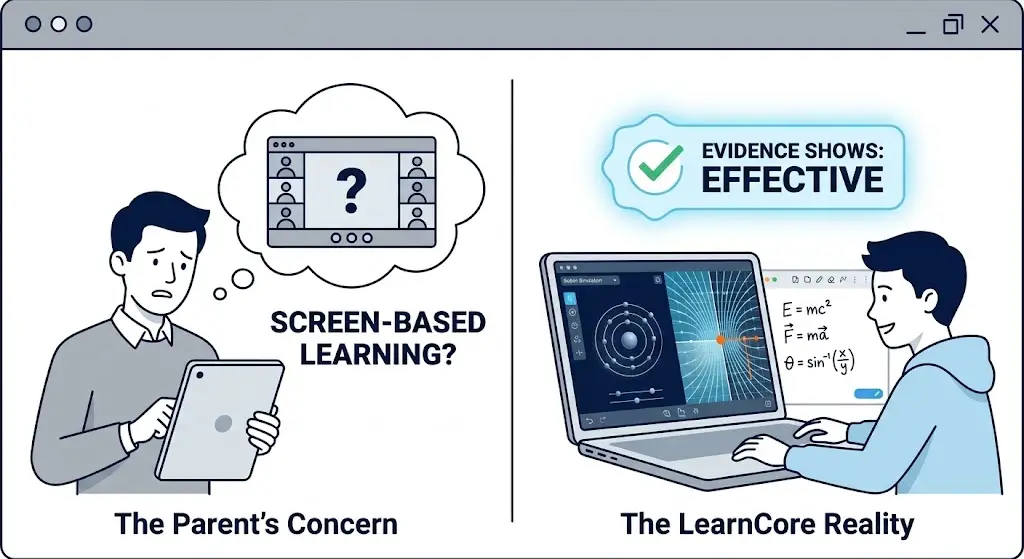
Online tutoring for HSC Chemistry and Physics in a purpose-built digital environment eliminates this cost entirely. Senior students join a session from their study desk, with their own notes, textbooks, and past-papers in front of them. The session ends and they are immediately back in their study space, with no transition time and no travel fatigue.
Beyond the time recovery, the digital learning environment offers structural advantages for science subjects specifically. Complex chemical equations, molecular orbital diagrams, force vector diagrams, and electromagnetic induction derivations can be co-annotated in real time on a shared digital whiteboard. Both tutor and student can write, highlight, and build diagrams simultaneously, which produces a more active and responsive learning dynamic than the whiteboard at the front of a tutoring centre classroom.
Digital resource libraries, including NESA marking guidelines, past HSC papers with annotated solutions, module-by-module formula references, and targeted practice sets, can be shared instantly during a session and accessed independently between sessions. A student revising at 10pm before an assessment has access to the same quality of resource they would have in a face-to-face session.
Explore LearnCore’s online tutoring programmes for senior students built around this infrastructure, and the results reflect it.
The Transition Is Manageable With the Right Support
The Year 11 science jump does not have to result in a lost year of marks and shaken confidence. It requires a specific response: understanding what the course now demands, building study habits that match those demands, and accessing specialist support that can identify and close gaps before they compound.
Students who make this adjustment early in Year 11 do not just recover their marks. They arrive in Year 12 with a system, a formula fluency, and an exam-response discipline that puts them in genuine contention for top band results.
If your child is finding the senior science transition difficult, reach out today to arrange an initial session and discuss where the gaps are and how to close them.
Book Your Free Trial Lesson
Tell us about your child and we will match them with a specialist HSC tutor. The first lesson is free, with no lock-in.
- WWCC-verified tutors
- First lesson free
- No lock-in contracts
- A real person calls you back the same day, usually within two hours.
- No payment and no account. The first lesson is free either way.
- Your number is used to arrange the lesson, nothing else. Reply STOP to any text and we stop.
Rated 5 out of 5 stars by Sydney parents