How to Overcome Maths Exam Anxiety: A Practical Guide for High Schoolers
Your Child Knows the Work. So Why Do the Marks Not Show It?
You have watched them at the kitchen table. They work through practice problems, ask the right questions, and seem to genuinely understand the material. Then the exam results come back and the marks simply do not reflect the effort. Your child is frustrated. You are frustrated. And the most common advice you hear, “just study harder,” starts to feel hollow.
If this sounds familiar, you are not imagining it. What you are seeing is not a knowledge problem. It is an anxiety problem, and the two require very different solutions.
Why Exam Anxiety Blocks Memory, Even in Capable Students
When a student walks into an exam room feeling genuinely threatened by the stakes, the brain’s stress response kicks in. Cortisol and adrenaline flood the system. The brain shifts into a protective mode designed for survival, not for retrieving the formula for the area of a trapezium.
The prefrontal cortex, the part of the brain responsible for reasoning, working memory, and retrieving stored knowledge, becomes functionally suppressed under high stress. This is why a student can go completely blank on a concept they revised perfectly the night before. It is not laziness or carelessness. It is neuroscience.
The “just study harder” advice fails here for a simple reason: the student already knows the content. The gap is not in their bedroom study sessions. The gap is in their ability to access that knowledge under pressure, in a silent room, with a clock ticking.
3 Strategies That Actually Work
Strategy 1: Taming the Clock
Time pressure is one of the biggest triggers of exam anxiety. A student who has not practised working under time constraints will almost always slow down when stressed, burning precious minutes on questions they should be moving through confidently.
The fix is deliberate time budgeting, practised before the exam:
- Divide the total marks by the total minutes available to get a rough “marks-per-minute” rate.
- Allocate time to each section before starting, and write those allocations at the top of the paper.
- Set a physical timer during home study sessions, not as pressure, but to build a reliable internal clock.
When students practise this routine repeatedly, the time management itself becomes automatic. That removes one source of panic before the exam even begins.
Strategy 2: Simulating the Exam Environment
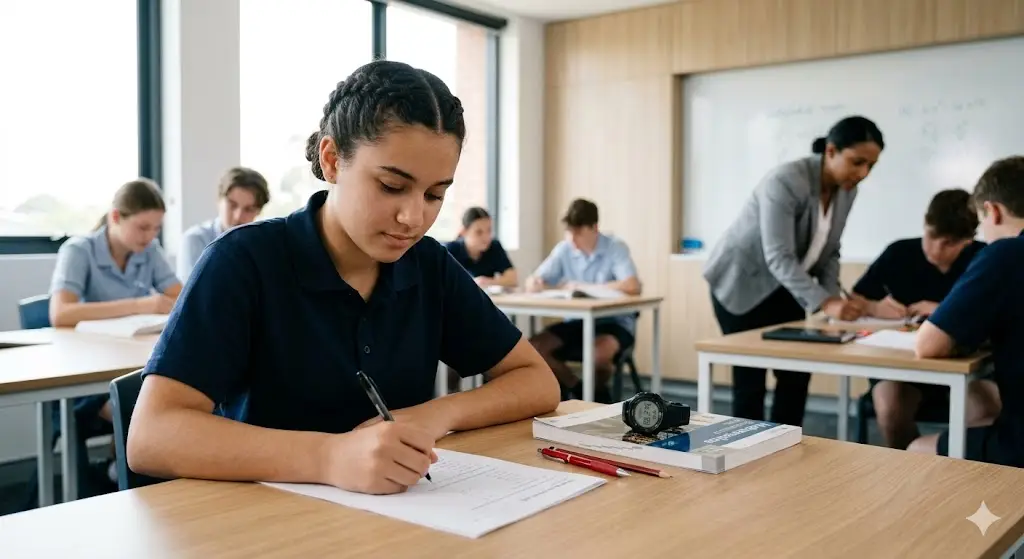
Reviewing notes and doing practice problems in a comfortable bedroom is a very different cognitive experience from sitting a real exam. The stress of the exam room is partly unfamiliarity. The way to reduce that stress is to make the environment feel ordinary.
Introduce timed, “blind” practice papers at home:
- Print a past paper and complete it with no notes, no calculator (where the real exam prohibits one), and no interruptions.
- Sit at a clear desk, not on a bed or couch.
- Set a timer for the exact exam duration and stop when it ends, regardless of where they are up to.
- Review the paper together or with a tutor afterward, focusing on where time was lost, not just where answers were wrong.
Running this process three to four times before a major exam block dramatically reduces the shock factor of the real thing. The brain begins to associate “exam conditions” with something familiar rather than something threatening.
Strategy 3: The First-Pass Method
Nothing accelerates exam anxiety faster than getting stuck. A student who spends eight minutes on one question they cannot solve has now lost time across the rest of the paper and built up a layer of psychological pressure that follows them through every subsequent question.
The First-Pass Method teaches students to protect their marks:
- First pass: Move through the entire paper quickly, answering every question you can solve with confidence. Skip anything that feels uncertain or stuck.
- Second pass: Return to the questions you skipped, now with more time and a calmer state, because you have already locked in marks from the rest of the paper.
- Third pass (if time allows): Review answers and check working.
This method is powerful because it ensures students never leave easy marks on the table. It also delivers a genuine psychological boost: completing questions, even the simpler ones, builds confidence momentum that carries into the harder problems.
Building Exam Resilience Is Not Something You Can Do Alone
Content knowledge will only take a student so far. The step that separates consistent performers from capable students who underdeliver is exactly what we have described above: the ability to stay calm, strategic, and methodical when it counts.
At LearnCore, our tutors are trained to identify whether a student’s difficulty lies in content gaps, exam technique, or both. We develop personalised exam strategies based on each student’s specific patterns, not a generic formula.
If you have a high schooler who works hard but struggles to perform in exam conditions, a diagnostic session with one of our tutors can make an immediate difference. We will assess where the pressure points are and build a strategy that fits your child’s learning style.
Understanding how performance maps to your final rank is essential. You can read our comprehensive breakdown on how scaling works to see exactly where your child stands.
Get in touch today to book a free initial consultation and help your child walk into their next exam prepared, not just studied.
Book Your Free Trial Lesson
Tell us about your child and we will match them with a specialist HSC tutor. The first lesson is free, with no lock-in.
- WWCC-verified tutors
- First lesson free
- No lock-in contracts
- A real person calls you back the same day, usually within two hours.
- No payment and no account. The first lesson is free either way.
- Your number is used to arrange the lesson, nothing else. Reply STOP to any text and we stop.
Rated 5 out of 5 stars by Sydney parents