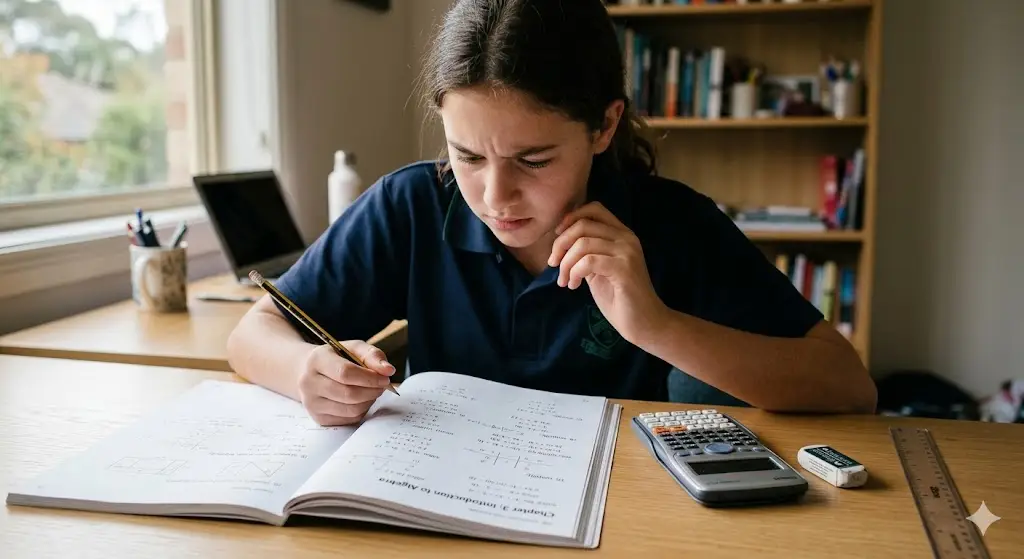

The Jump from Year 6 to Year 7 Maths: How to Stop Your Child Falling Behind
A Sudden Change That Catches Families Off Guard
Primary school maths is largely concrete. Students learn to add, subtract, multiply, and divide. They work with fractions, decimals, and percentages. They can see and touch what they are learning, and there is a clear logic to every step.
Then Year 7 begins.
Suddenly the numbers disappear and letters take their place. Algebra asks students to think about quantities that are unknown, to manipulate equations without a definitive answer in sight. The spatial reasoning of geometry becomes more demanding. Number theory grows abstract. And for the first time, many students who were strong and confident in primary school find themselves confused, and quietly losing faith in their own ability.
This transition is one of the most significant academic shifts in a student’s entire schooling journey. It is also one of the least talked about.
Why the First Two Terms of Year 7 Determine More Than You Think
Maths is cumulative by nature. Every new concept builds on something that came before it. Under the NESA Mathematics curriculum for Stage 4 (Years 7 and 8), the foundational concepts introduced in Terms 1 and 2 of Year 7 are not standalone units. They are the building blocks that every subsequent topic in Year 8, Year 9, and beyond depends on.
A student who develops a shaky understanding of algebraic expressions in Term 1 will struggle with linear equations in Term 2. A student who misses the logic of linear equations in Year 7 will find simultaneous equations in Year 9 close to impenetrable. The gap does not stay the same size. It compounds.
What begins as a few missed foundational steps in Year 7 can become a significant confidence and performance gap by Year 9 — and the disadvantage compounds further as students move toward their senior HSC choices. Gaps in maths do not close themselves. This is why early intervention is not an overreaction. It is genuinely the most effective time to act.
3 Warning Signs Your Child Is Quietly Struggling
Students rarely say “I do not understand algebra.” More often, they go quiet, develop avoidance behaviours, or mask their confusion behind apparent effort. Here are the signs to look for:
1. Homework is taking far longer than it should.
If a maths homework task that should take 30 minutes is regularly stretching to 90 minutes or more, your child is likely spending the bulk of that time trying to work out what they are being asked to do, not practising a skill they already have. Long homework sessions are not always a sign of diligence. Sometimes they signal confusion.
2. They are memorising steps rather than understanding concepts.
Ask your child to explain how they solved a problem. If they can recite the steps but struggle to tell you why those steps work, they are relying on rote memory rather than genuine understanding. In early primary school, this can be enough to pass. In Year 7 and beyond, it breaks down quickly when problems are presented in slightly unfamiliar formats.
3. They are avoiding maths altogether.
Avoidance is the clearest signal of anxiety and lost confidence. This might look like “forgetting” to do maths homework, claiming they have no assessment coming up, or becoming irritable or withdrawn when maths comes up at home. Students who previously enjoyed the subject and now resist it are telling you something important.
Catching It Early Makes All the Difference
The good news is that the foundational concepts of Year 7 maths are not inherently difficult. With the right support, most students can fill gaps quickly and rebuild confidence in a matter of weeks, not months.
At LearnCore, we work with Year 7 students and their families from the very beginning of the high school journey. Our tutors identify exactly where a student’s understanding is solid and where it has started to slip, using a structured foundational skills assessment designed specifically for the Stage 4 curriculum.
Early intervention is not about admitting failure. It is about protecting the academic confidence your child has spent six years building, before a few confusing concepts quietly erode it.
If your child has recently started Year 7, or is finishing Year 6 and preparing for the transition, reach out today to book a foundational skills assessment. It is one of the most valuable investments you can make before the gaps have a chance to grow.
Book Your Free Trial Lesson
Tell us about your child and we will match them with a specialist HSC tutor. The first lesson is free, with no lock-in.
- WWCC-verified tutors
- First lesson free
- No lock-in contracts
- A real person calls you back the same day, usually within two hours.
- No payment and no account. The first lesson is free either way.
- Your number is used to arrange the lesson, nothing else. Reply STOP to any text and we stop.
Rated 5 out of 5 stars by Sydney parents